
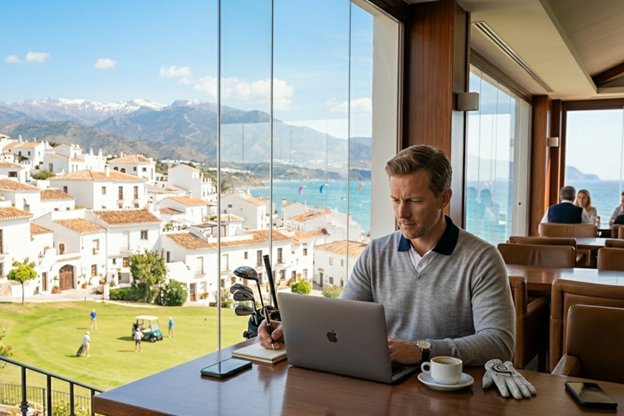
[Image Source: Created by Gemini]
Ask any seasoned remote worker what the essentials for their lifestyle are, and the answer usually incorporates some amalgamation of the following: reliable connectivity, affordable living costs, a fulfilling local culture, and things to do outside of working hours to make the whole thing feel worthwhile.
Andalucía, the sun-drenched region of southern Spain, has been ticking every one of those boxes for a growing community of international working professionals, who have made it their permanent or semi-permanent home. With roughly 300 days of sunshine per year, it’s easy to see why Andalucía has a legitimate claim to being one of the sunniest corners of Mainland Europe.
However, sunshine alone does not build a life; what keeps digital nomads and remote workers here long after the novelty of a new country and lifestyle has worn off, is something far more nuanced and harder-to-quantify. With Andalucía, professionals migrating here temporarily or permanently earn a valuable quality that transcends all the others: a way of life that genuinely supports the rhythm that location-agnostic work warrants.
Harnessing the Mediterranean life for productivity
Many newcomers tend to see the Andalucían pace of life as something to adjust to, rather than something to embrace for the long run. This often happens for workers who migrate to the quiet, tranquil spots in Andalucía from bustling metropolises like London, who can at first struggle to get used to the long lunches, afternoon lulls, siestas, and evenings that begin at nine. In practice, for remote workers who are already accustomed to their own unique schedules, this cultural way of life supports a productive working day where they’re not confined by conventional 9-5 parameters.
The science behind a more relaxed work-life balance is well-established; structured breaks correlate with improved concentration, and the social dimension of Andalucían culture, built around community and active living, reduces the feelings of isolation that remote work can sometimes bring. For many this is a firm upgrade as opposed to a lifestyle compromise.
Andalucía is a region built for active living
One of the most tangible benefits of choosing Andalucía as a remote base is the sheer density of world-class leisure options. For many residents, the "lunch break" evolves from a quick sandwich at a desk to a focused session of outdoor movement.
The Costa del Sol alone is home to nearly 100 golf courses, earning it the nickname "Costa del Golf." It is one of the few places in Europe where a round of 18 holes is a viable Tuesday afternoon prospect even in January. However, for the digital nomad, the transition from hours of laptop use to the explosive rotation of a golf swing can be a recipe for strain. While you don't need to be a professional to enjoy the local fairways, maintaining a baseline of flexibility is key to staying on the course. To truly integrate the sport into a healthy working week, many remote workers focus on functional mobility to undo the "office chair" posture. Incorporating specific golf exercises to improve your game, such as those curated by the experts at Golf Swing Systems, ensures that your physical health keeps pace with your handicap.
The appeal of Andalucía goes well beyond golf, however, with an abundance of hiking trails through the Sierra Nevada. Hiking is another activity that slots neatly into a remote working lifestyle, and the Sierra Nevada gives Andalucía one of the most spectacular mountain playgrounds in all of Europe. Covering nearly 175,000 hectares of protected land, it is the largest national park in Spain, and home to Mulhacén, the highest peak on the Spanish mainland at 3,479 metres. For those wanting to plan routes in advance, Trek Sierra Nevada is a well-regarded resource run by long-term residents of Granada, with accurate, detailed guides to self-guided walks across the region.
Then there is Tarifa, sitting at the southernmost tip of Spain where the Atlantic meets the Mediterranean. Tarifa is widely regarded as the kitesurfing capital of Europe, and with good reason: the town regularly experiences two prevailing winds, the steady Atlantic Poniente and the stronger easterly Levante, which between them deliver reliable conditions for most of the year. The 10km bay offers a stretch of wide sandy beach with spots suited to every ability level, from complete beginners at Los Lances Norte to more advanced riders at Valdevaqueros. MACkite Boardsports Center, a respected name in the kite world, has published a thorough travel guide to kitesurfing in Tarifa covering spots, wind conditions, and practical tips for planning a stay around the sport.
For remote workers who love variety, movement, nature, and tranquillity, this level of access is difficult to find anywhere else.
Cities that boast connectivity and community
Andalucía's major cities each bring something unique and appealing to the table. Málaga, on the Costa del Sol, is particularly popular for digital nomads, thanks to its well-developed coworking scene, growing ratio of young international travellers, and an urban energy that makes networking from scratch relatively straightforward. Its airport connects to most major European cities, which is ideal for those who plan to balance time between Spain and somewhere else for the time being, or who aren’t planning to relocate permanently.
Seville, the regional capital, boasts a thriving cultural scene and a rich history, which, coupled with a comparably lower overall cost of living versus other cities in northern Europe, is hard to overlook. Granada itself offers a more bohemian lifestyle and atmosphere, thanks in part to its vibrant student culture. Those who prefer the coast without the bustle of Málaga may prefer towns like Nerja, which offers a quieter, more serene feel with the same quintessential perks of sun, sea, and the outdoors.
Essential considerations worth knowing
The cost of living in Andalucía is comparatively lower than other European cities, but it does vary and this shouldn’t be considered ‘across the board.’
Coastal areas, particularly around Marbella and the western Costa del Sol, are understandably a bit more expensive, but further inland, and in cities like Granada and Almería, the same quality of life is available at a measurably lower cost. Many rental properties in both urban and rural areas are well set up for remote working, which is handy for those seeking longer-term stays.
Spain's Digital Nomad Visa, launched in 2023, has made the bureaucratic pathway to entry significantly more straightforward for non-EU nationals. Combine this with Andalucía’s existing nomad-friendly infrastructure, which includes English-speaking professional services spanning healthcare, finance and legal, the barriers for an extended stay aren’t as intense or disruptive.
Why Andalucía works
What Andalucía ultimately offers remote workers is a complete package of an active lifestyle, a healthy work-life balance, an inherently strong infrastructure and a favourable climate. Essentially it’s a culture that’s equal-parts vibrant and relaxing, thus cultivating an environment where working doesn’t have to come at the expense of living, and vice versa.
For anyone weighing up where to base themselves for the next chapter, the question is less whether Andalucía works, and more whether you’re ready to take ownership of a work-life balance that enriches you every single day.
Author: Justin Aldridge